Showing posts with label research. Show all posts

Sunday, 8 February 2015

Title Sequence // Typography


For our title sequence we chose six potential types for the title of the film- these fonts fit our genre and our narrative well.

Chosen from dafont.com and asked an audience of their opinion of the typography and which font they preferred. 'Decibel' was the most popular amongst our audience with 'Shrapnel' the second most popular. We decided to use 'Shrapnel' as the typography for the cast in our sequence. Both these fonts are very effective and- in our opinion- the most effective out of the six.


Props// Costume// Setting IDEA

Our storyboard allowed Hannah and I to plan what props and costumes we need and the setting our sequence. We needed to mise en scene to match our mystery crime genre and established a rough idea of what we needed:

Costume: 

   The male character: 

  • Black gloves 
  • Smart trousers 
  • A jumper 

   Female character: 

  • Red coat 
  • Red/black heels 
  • Black skirt or trousers 
  • White shirt 
  • Makeup - red lipstick 
  • Small handbag 
  • Police costume

  Props: 

  • A book 
  • Files and case about acid attacks 
  • White ceramic cups 
  • Small table 
  • Newspaper 
  • Pictures of female character 
  • Police badge 
  • Cafe menu 
  • Bus/train map 

Setting:

Monument (Waterloo) 
Trafalgur Square 
Cafe's located in London
Charing Cross bridge 
Embankment tube station 

Thursday, 22 January 2015

Character Profiles

Hannah and I have applied Propp's theory on our two main characters.

  • Protagonist- Works to defeat the antagonist
  • Antagonist - Goes against the hero
  • Donor- Gives the hero something to help aid them on their journey
  • Helper- Helps the hero
  • Dansel in Distress- Often the 'prize' for the hero, seeks the hero for help.
  • Dispatcher - Character who identifies the issue and calls for the hero's help.
  • False Hero- Attempts to take credit for what the hero has done and/or attempts to marry the dansel in distress.


Character Profiles 


Basic Statistics:

Name: Catherine Moore
Gender: Female
Relationship status: Engaged
Age: 29
Nationality: British
Current Residence: London
Occupation: Police Sargeant
Income: Estimated 40,000

Talent/Skills: Intuative, Perceptive
Physical Characteristics:
Height: 5,7
Weight: 10 stone
Race: Cacuasian
Eye Colour: Blue
Hair Colour: Brown
Distinguishing Features: Freckles, moles
How does he/she dress: Ladylike, classy
Character Involvement in Story:
Relationship with other characters:
  • Robert Johnson- Johnson is assigned Catherine Moore as his partner in the police force after the death of his former partner. They do not get along as Johnson remains hostile towards her and does not work with her well much to Moore's disdain.

Basic Statistics:

Name: Robert Johnson
Gender: Male
Relationship status: Single
Age: 32
Nationality: British
Current Residence: London
Occupation: Police Sargeant
Income: Estimated 40,000

Physical Characteristics:
Height: 6,2
Weight: 11 stone
Race: Cacuasian
Eye Colour: Brown
Hair Colour: Brown
Distinguishing Features: freckles
How does he/she dress: Smart, concealed,
Character Involvement in Story:
Relationship with other characters:
  • Catherine Moore- Johnson is assigned Moore as his partner much to his disdain as he hoped for a male partner to help him with his cases. He shows this dislike to her as he does not take her seriously in the profession due to her young age and due to the fact she is a woman  in a seemingly 'male profession'.


Audience Research: Title Sequence Feedback


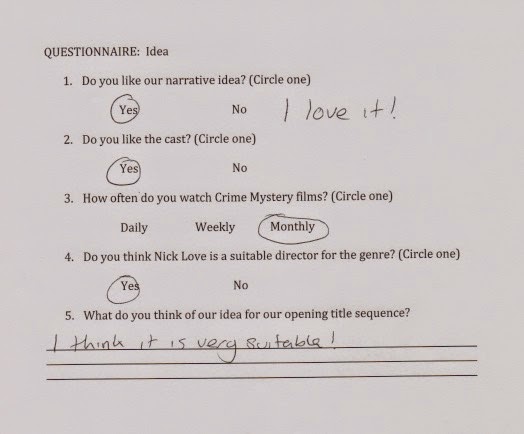
We gave out the questionnaires to those who fit in our 18-40 target audience of men and this enabled us to establish our idea further. Hannah and I found out the majority of our target audience liked our idea and casting choices and thought the idea of the title sequence was interesting. This gave us clarity in the narrative of our plot as we now know our title sequence appeals to our desired audience. 


Audience Research: Title Sequence


As part of our audience research Hannah and I conducted another questionnaire revolving around our title sequence. We asked our target audience of their opinions of the idea, the genre and the cast of the film. This questionnaire will enable Hannah and I to further develop our idea and further establish the details of the sequence and the film. 


Wednesday, 21 January 2015

Narrative Plan


Hannah and I planned the narrative of our film and determined the genre. We established the main characters in our film, target audience, cinematic style, conventions of our genre and, using Todorov's theory, we planned our narrative.

Voicenote: Discussion of Title Sequence

Hannah and I had a lengthy discussion of our title sequence in terms of cinematography, sound, mise en  scene and editing. We also discussed narrative and where it will be shot.


Tuesday, 20 January 2015

Audience Research: Feedback


From our research, Hannah and I established our audience liked to watch films as a way to escape from ordinary life, a range of them watch films weekly and also enjoy watching British films. This information will help Hannah and I gain a clearer idea as to what our title sequence needs to contain in order to reach out to our audience. In addition, we found out the majority of our audience enjoy crime films which tells us our genre fits the audience very well. 

This questionnaire will help Hannah and I develop our title sequence. 


Audience Research

Hannah and I conducted two questionnaires to be given to those of our target audience of 18-40 year old men. We will use this information to suit our title sequence to our audience and also gain a clearer idea of what our audience likes and dislikes. In addition we will also determine whether our genre fits our audience and it will also enable us to change anything in the development of our title sequence. 

Monday, 19 January 2015

Powerpoint: Saul Bass

Powerpoint: Kyle Cooper


As part of our research into title sequences, Hannah and I researched into well known designer, Kyle Cooper. We chose Kyle Cooper as part of our research because he has worked on similar title sequences for the similar genre we have chosen.

Sunday, 18 January 2015

Case Study #5: The Wire

David Simon's The Wire, season 1 title sequence 


David Simon's 2002 series The Wire, is a HBO TV crime drama series which is constructed with the use of micro features. The opening title revolves around the police and a drug dealing organisation. This adds to the narrative enigma as the audience question what the substance being dealt is and what the police are doing. The non diegetic soundtrack of a version of Way Down In The Hole by the Five Blind Boys of Alabama could reflect on the police officers personality and set the tone of the series.


The sequence begins with an extreme close up of a person making a call. The audience are left oblivious as to who this person is and whether they are an antagonist or
protagonist; their identity is kept a secret which makes the audience curious enough to continue watching. Using police iconography, the audience is able to understand what is happening throughout. The call is shown to be tracked by police, conveying to us that the person making the call is an antagonist. This is shown as the camera cuts to a close up computer screen of a wiretap activity. In addition, this close up could leave the audience wondering why the camera was so close up, we are left questioning whether there is something else on the screen that we are not meant to see.


Throughout the sequence, we do not see the actors in the series, the sequence shows the making of the drugs, police busts and court orders. Unlike a typical TV opening title, who the actors play in this series are kept a secret presumably in order to not give anything away to the audience. The camera cuts to a person talking to someone in the car. The use of a POV shot positions us in a car, which allows for the audience to fully immerse in the action on screen. It can be suggested that we are put in a position of a police officer giving us a sense of power amongst the criminals . The white typography used stands out against the background, the type used looks like chalk which could refer back to the idea of police outlining the positions of bodies with chalk.
The audience are sent back inside to an extreme close up shot of a person making a substance. Again, the use of a close up restricts the audience's view of the character's surroundings. However, it can suggested the person making the substance is highly skilled and knowledgeable as there seems to be no sense of reluctance or fear for what they are doing.


The camera then goes onto cut to a drug trade amongst two people which we assume to be teenage boys due to stereotypes revolving drugs and gangs. A POV shot could place the audience in the scene as if we are part of this drug trade. Again, the identities of these boys are hidden, allowing all of our focus to be on the drugs. The arrangement of this sequence tells the audience a story, the boy ultimately succumbs to his death leaving the drugs to fall out of his hands, to which our attention is drawn to due to the close up. This shot also stereotypically suggests to the audience that these criminals are black teenagers in some sort of gang.


The camera cuts to an extreme close up of a hand- this shot tells us the victim is a mixed race person possibly part of a drug gang. The hand is positioned in the centre of the frame drawing the audience's attention directly on the hand. However, the frame also shows some sort of drug, drawing our focus away from the hand and towards the unknown substance. This further adds to the crime genre of the series as we can tell some sort of criminal activity has been taking place in the sequence. In addition, this makes us curious as to what is going on and makes us want to watch more.


As the sequence continues, we are taken to another location. The position of the camera places us looking down upon a car- this fuels our suspicions and makes us question what is happening. The long shot puts us behind a gate, putting the audience in a position as if we are surveying the car- it can suggest the POV shot puts us in the position of a police officer. The camera cuts to a person, presumably a police officer, zooming in on his camera. The shot of the car zooms in as if the audience is the camera. The shot turns to black and white, this use editing could make us seem as if we are part of the investigation. This use of black and white also adds to the old style of the series.

The sequence progresses to yet another unknown character at a pay phone. Throughout the sequence, the audience is left oblivious to the identity of the characters in the series, the only knowledge of the characters we are informed are the names of the cast. The long shot shows us the sequence has transitioned from day to night. The use of darkness creates a sense of mystery as everything is left in the dark. A close up shot shows the audience the dirty pay phone, suggesting the series is set in a rough area of America. The audience's attention is focused on the titular wire further conveying to the us of what the show is about.    


We next see an extreme closeup of an unknown person. The close up of the wire in the person's ear further conveys the crime genre of the series. This also connotes to us that the person  is listening on the mysterious person's phone call- the police are superior at this moment to the criminal. The camera crabs to the right, showing the audience a man smoking a cigarette; which could make the audience think this police officer is calm and collected- the cigarette also adds a sense of slickness to the character as if he does not care for what the criminals are doing as he knows the police will win nonetheless. 


The Wire's title sequence shows the audience various shots of a phone wire, an extreme close up shows a blurred version of  a waveform presumably the waveform of a voice. Another extreme close up of a man, possibly a criminal, on the phone. This leads to a close up of a now visible waveform; which could suggest to the audience that the police prevail against the criminals as they successfully manage to transmit into the criminal's phone call.  The composition of uneven placements in various shots of the sequence suggests a sense of misdirection in the series as if to tell the audience that everything is not as it seems. 


However, a shot of a surveillance camera being destroyed by a civilian could make the audience and the police aware that the criminals could be one step ahead of them. In addition, this shot adds a sense of defiance against the police and using this shot puts the audience in the position of a camera- this may give us another perspective an unbiased perspective as we are not in a position of the police or a criminal but can inanimate object. 


The sequence ends with a blurred and grainy long shot of a group of people- their actions are left unknown to the audience which further fuels the mystery of the series and makes us want to watch more. 


The use of narrative in the title sequence is what I would like our title sequence to embody. As the sequence focuses heavily on the narrative not the characters in the series, this makes for a more interesting watch for the audience and makes us more anticipated to watch which is what we want for our sequence. 


Case Study #4: The Game

1997's The Game directed by David Fincher.

The Game (1997) — Art of the Title


David Fincher's The Game, 1997, is a mystery thriller film which is constructed with the use of micro features. The opening titles show a flashback to a family at their child's birthday party. This adds to the narrative enigma as the audience question what relevance does this flashback have on the film.
The sequence begins with the company credits to which it breaks into puzzle pieces. This could refer to the 'game' which the audience needs to solve. In addition, this carries the enigma as the we question why these credits are broken into puzzle pieces and also emphasises the mystery element in the film as we are left to figure out what is happening. White simple typography is used for the title of the film yet it's effective as it's bold and strong. The use of capital letters conveys there will be an element of action in this film. Similar to the company credits the screen breaks into puzzle pieces, taking the film title name with it- again, this shows the audience needs to figure something out that happens in the film.


The audience are introduced to a young boy with his father, from a mid shot we can see the boy who  constantly looks up to his father both literally and possibly figuratively. This could tell us this film has a family element to it. Their clothing could tell us they are wealthy which is further suggested through the use of the orchestral non diegetic soundtrack. It's slow tempo adds a sense of elegance and sophistication. In addition, the music also conveys a sense of mystery within the sequence and makes the audience question whether the characters shown are hiding something. The scenes are made to look as if they are old home videos, we may know this because of the grainy affect used in the scenes and abrupt cuts in between. Furthermore, cellophane jumps are used to transition the audience from the majority of the clips creating a sense of mystery as we may question whether we are getting the full clip as we are shown short snippets through the use of abrupt cuts.


The scene flashes to a group of people in a kitchen. This use of editing could convey a flashback, giving the audience a sense of nostalgia as they watch the sequence as if they are looking back on the boy's life. Through this mid shot, the audience can see a table full of food which further suggests that the family comes from a wealthy background. We can see the use of low key natural lighting creating a sense of realism in the sequence yet the shadows can also connote there are secrets that are yet to be revealed. They characters appear, from their body language, to be calm however, a sense of mystery is created as we question the significance of this home video.

We then see a close up of a person, presumbly male, placing an ingredient into a cup. The audience can suggest that the man's white shirt looks like a lab coat, suggesting an element of science or intelligence is involved in this film. In addition, this shot could tell us that there is more to the main character than we know and throughout the film we will be discovering all aspects of his personality. This shot has various jumps to it, emphasizing the style of a home video in the sequence.


The shot then cuts to the identity of the man through the use of a mid shot. This use of match on action makes the shot flow and shows continuation from the previous shot. The audience sees the man happily smiling into the camera possibly suggesting those at the party are all friends and are enjoying their time together. A sense of community is conveyed as we can see people from different races all getting along together. The man is positioned in the center of the frame showing he is of some importance however, the mid shot does not draw a focus as his face does not fill the entire screen. This could suggest the distance between the audience and him are vast and he could play an important possibly antagonist role in the film.  


The sequence continues as a close up shows the audience of  a woman's hand arranging flowers. Throughout the scene, white is heavily used suggesting safety and purity- this could possibly represent the children in the sequence and could suggest children and/or childhood plays an important role in the film. The black gloves and pearl bracelet connotes the woman is of high class and wealth. Similar to the previous shot, match on action is used to show the audience her identity. She is positioned to the left on the frame, suggesting she is not of importance in the sequence and possibly the film.

A long shot is shown as the sequence goes on, parasols are shown in the garden and the characters, presumably waiters, are seen carrying a cake. This further establishes the family who threw the party are from a wealthy background. The classical piano music along with the style of the home video could make the audience feel uncomfortable as the shots could be seen as disturbing and eerie as we wait for something to happen.


We are put in the position of a child watching a puppet show through the use of a POV shot. The style of the puppet show could suggest these 'home videos' are set in the older times presumably the 1960s. The use of puppets could be associated with mystery and crime as commonly criminals are referred as 'puppermasters'. This may convey the main character is to take part in criminal activities in the film. The camera cuts to a long shot of the children who were watching the show. They are mostly dressed in formal attire of white clothing which can connote they are all of wealthy backgrounds.

The camera quickly cuts to a mid shot of the majority of the children leaving as the show has finished. This sharp cut could represent the pace of the film- it can be suggested, in terms of narrative, that the film will be sharp with plot twists that keep the audience interested. The abrupt cut could show how quick the puppet show lasted which could represent how quickly childhood lasts. This could be a reference to the film as the main character could feel as if his childhood went too fast as he now could be in the adulthood.

A mid shot of a person's silhouette is shown to the audience- we automatically assume it is a male due to the figure of the man. This use of low key lighting adds a sense of mystery to the sequence as the audience questions what he is hiding from us.

The sequence continues to an extreme long shot of a man walking towards the grand house. This shot shows the audience the wealthiness of the owner. It can be suggested, the owner could be this man as he is a focus in this shot- his white suit also shows his wealth and can also connote innocence. As he is walking, he abruptly turns back around and walks towards the camera. This mid shot shows us his body language, he looks as if he is hiding something, raising our suspicious on his intentions. The dullness of the shot could suggest this 'home video' is incredibly old and worn out, adding a sense of nostalgia to the sequence.


The shot cuts away to a toy boat drifting away in the water; which could represent the main character's childhood drifting further and further away from him. It can be suggested that this shot represents a calm before the storm, possibly suggesting that something bad is to happen.

Another reference to the water is constructed, this time a long shot shows a two boys pushing another boy in a swimming pool. The audience can suggest water plays a important role in the film, possibly a tragedy could happen involving water. This use of the swimming pool further shows the audience of the family's wealth.
A shot of clowns are shown, suggesting this is a child's birthday party. Although clowns have positive connotations of cheerfulness and laughter, the solemn soundtrack makes the clowns seem sinister. It can be suggested these clowns represent fear. We can suggest the main character may face a childhood fear of his in this film.


As the sequence almost comes to the end, the father and son shown at the start reappear. This time the boy is given a model boat from his father which further adds to the references to water in this sequence, it could be clear to the audience that water will play an important role in this film. The father stays for a while before leaving. His son is left looking vulnerable as he stares right in the camera not at his father. This adds a sense of uneasiness and helplessness for the audience as we want to help him but we can't. Slow motion is used as the father walks into the darkness which suggests he is walking into something we can't see. The audience can suggest he is walking into something sinister, possibly his death as we do not see him again. 

A contrast is used as a close up of the young boy is replaced with a close up of an adult man, presumably him, rising after splashing his face with water. This shot could suggest how quick we all grow up from a happy child to a miserable adult. A final reference to water is added in, furthering our suspicions and adding to the mystery of the film, a mystery we must watch on to resolve.